- Home
- Gifts of the Holy Spirit
- How Jesus Exercised the Gifts of the Spirit
How Jesus Exercised the Gifts of the Spirit: Your Blueprint for Supernatural Ministry
By Don Bell / Kingdom Anointing
Have you ever wondered how Jesus exercised the gifts of the Holy Spirit to perform miracles? While many believe He relied solely on His divinity, Scripture reveals a more profound truth: Jesus ministered as a man empowered by the Holy Spirit.
By examining His ministry, we discover a practical blueprint for every believer to operate in the same supernatural power. Having examined the purpose behind the gifts of the Spirit earlier in this series, we now look to Jesus, our perfect role model, to understand the potential available to you today.
If you're new to this series, you may want to start with the gifts of the Holy Spirit to understand what the nine gifts are, or the purpose of the gifts of the Spirit to grasp their purpose. Regardless, this article stands alone as a study of Jesus' ministry model.
The Mystery of the Incarnation: How Jesus Exercised the Gifts of the Spirit as a Man
 How Did Jesus Perform Miracles? He Used Spiritual Gifts
Source: ©dovapi/Depositphotos.com
We read in Scripture, "Great is the mystery of godliness: God was manifested in the flesh, justified in the Spirit, seen by angels, preached among the Gentiles, believed on in the world, received up in glory" (1 Timothy 3:16).
Jesus is the Son of God, one with God the Father, and one with the Holy Spirit. His Incarnation is a mystery beyond our human ability to explain, and for that reason, people tend to make Jesus so mystical that they cannot relate to His human life and earthly ministry.
To examine how Jesus exercised the gifts of the Spirit, we need to look beyond traditional religious portrayals of Jesus and understand that while He retained His deity, He temporarily gave up His glory to experience life as fully human.
Embodied in human form (incarnate), Jesus surrendered the use of His divine abilities. Note that He did not renounce His divine abilities or attributes; He voluntarily surrendered His use of them.
Scripture says, "[He] emptied Himself [without renouncing or diminishing His deity, but only temporarily giving up the outward expression of divine equality and His rightful dignity] by assuming the form of a bond-servant, and being made in the likeness of men [He became completely human but was without sin, being fully God and fully man]" (Philippians 2:7 AMP).
Understanding that Jesus voluntarily limited His divine expression helps us grasp an important truth: He lived as an ordinary man in every observable way.
Beyond the Halo: Revealing the Human Side of Jesus
Isaiah prophesied of Jesus' physical appearance: "For He shall grow up before Him as a tender plant, and as a root out of dry ground. He has no form or comeliness; and when we see Him, there is no beauty that we should desire Him" (Isaiah 53:2).
Jesus didn't appear different from other men when He walked the streets of Jerusalem. Had His appearance been remarkable in any way, the New Testament writers surely would have mentioned it. He surely wouldn't have looked like the Old Masters' paintings, dressed in radiant robes, wistfully gazing heavenward, with a golden halo radiating from His head.
If Jesus walked through your local shopping mall today, you likely wouldn't notice Him. He would have woken from a night's sleep, showered, combed His hair, dressed in ordinary clothing, and driven to the mall. He might even stop by the food court to enjoy a coffee and a toasted bagel. Jesus got tired, hungry, sweated in the desert heat, shivered in the cold, and displayed healthy human emotions.
Before starting His ministry, Jesus learned to read and write, studied the Hebrew Scriptures (likely the Septuagint, the Greek-language version common at that time), and trained and worked as an artisan in an ordinary Galilean town. Nothing "beyond usual."
What made Jesus "beyond usual" was His supernatural ministry through the Holy Spirit's power, and He wants us to appear "beyond usual" too! As we explored earlier, Jesus promised we would do His works (John 14:12), and the Holy Spirit's gifts make this possible.
Since Jesus says we can do the same works, wouldn't we need the same abilities? Jesus was equipped with the gifts of the Holy Spirit, the very gifts He has made available to us!
Jesus' Divine Tools: Proving He Relied on the Holy Spirit's Power
Some argue that because Jesus is God, He didn't need spiritual gifts. However, we must consider how Jesus exercised the gifts as a man; having emptied Himself of His divine power, He chose to rely entirely on a divine power beyond Himself — the Holy Spirit.
This anointing became visible at Jesus' baptism when the Holy Spirit descended upon Him like a dove (Matthew 3:16). Immediately afterward, the Spirit led Him into the wilderness, and He returned in the power of the Spirit to begin His ministry (Luke 4:14). Everything Jesus did flowed from this Spirit-empowerment.
It so happens there are more than a few examples of Jesus exercising the gifts (supernatural abilities) of the Spirit in the New Testament. However, for the sake of brevity, let's look at just one example of each gift.
The Revelation Gifts: How Jesus Perceived the Unknown
- Word of Knowledge: Jesus exercised a word of knowledge when He perceived the thoughts of the scribes and Pharisees who wanted to accuse Him of blasphemy (Luke 5:21–26).
- Word of Wisdom: Jesus received a word of wisdom on how to deal with the Pharisees and the Herodians who attempted to catch Him in His words over the payment of taxes to Caesar (Mark 12:13–17).
- Discerning of Spirits: Jesus discerned an evil spirit when He delivered an epileptic boy (Matthew 17:14–18).
The Power Gifts: How Jesus Demonstrated Divine Authority
- Miracles: Jesus performed a miracle whenever He gave sight to the blind, cast out demons, and raised the dead (Luke 7:21–22).
- Gifts of Healing: Jesus exercised gifts of healing throughout His ministry and at times He healed all who came to Him (Matthew 4:23).
- Faith: Jesus exercised the gift of faith when He cursed the unproductive fig tree (Mark 11:12–14, 20–23).
The Utterance Gifts: How Jesus Spoke Life and Prophecy
- Prophecy: Jesus often spoke prophetically and on the night of His betrayal, He clearly prophesied that Peter would deny Him three times (John 13:37–38).
- Different Kinds of Tongues and Interpretation of Tongues: These two utterance gifts are the only gifts for which there isn't definite biblical proof of Jesus exercising them.
While Scripture doesn't explicitly record Jesus speaking in tongues, Luke 10:21 tells us "Jesus rejoiced in the Spirit." Whether this included praying or singing in heavenly tongues, we cannot say with certainty.
But given that Jesus was filled with the Spirit without measure (John 3:34) and that tongues is a gift of the Spirit, it's reasonable to believe He had access to this gift even if it wasn't publicly demonstrated in the Gospel accounts. For a deeper exploration of this question, see my article Did Jesus Speak in Tongues.
Walking in Jesus' Footsteps: Overcoming the "Sinless" Objection
When we study how Jesus exercised the gifts of the Spirit across the three categories — revelation, power, and utterance — we see a complete pattern for supernatural ministry that remains accessible to believers today.
These examples clearly demonstrate Jesus' reliance on the Holy Spirit's gifts. However, some argue that Jesus had a huge advantage over us when considering how He exercised the gifts of the Spirit. After all, He was the Son of God, born without sin!
It is true that lacking our sinful nature, Jesus could walk in a sure faith not compromised by feelings of unworthiness, guilt, doubt, or fear. Yet, we must not make Jesus' sinless nature our excuse for failing to do the same works that He did.
The central message of the New Testament is that Jesus endured the cross to rescue us from the consequences of mankind's rejection of God. His sacrificial death paid the penalty for our crimes against God's law once and for all, satisfying the holiness and justice of God. As Jesus declares, "It is finished!" (John 19:30).
There Is Therefore Now No Condemnation
Scripture affirms, "There is therefore now no condemnation to those who are in Christ Jesus, who do not walk according to the flesh, but according to the Spirit. For the law of the Spirit of life in Christ Jesus has made me free from the law of sin and death" (Romans 8:1–2). This means the Holy Spirit has freed us from the power of sin and its deadly consequences.
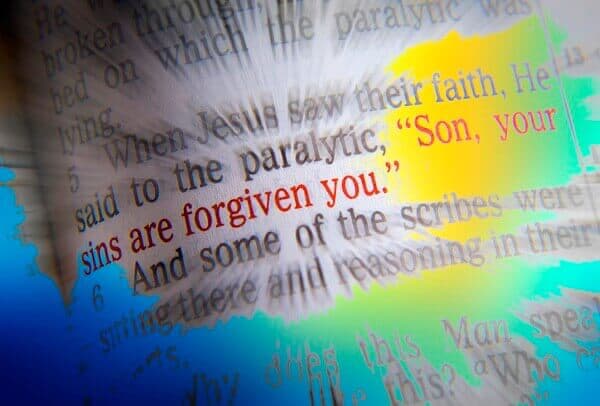 "Son, Your Sins Are Forgiven You" (Mark 2:5)
Source: ©Hriana/Depositphotos.com
Though sinless, Jesus in human form was tempted to disobey God. Satan tried to entice Him away from the right path, but Jesus never allowed Himself to go His own way with no thought of God. He never missed the high mark of His calling. Because He was tempted and knows our human weaknesses, He's able to effectively intercede for us as our High Priest in the presence of God the Father.
Scripture says, "For we do not have a High Priest who cannot sympathize with our weaknesses, but was in all points tempted as we are, yet without sin. Let us therefore come boldly to the throne of grace, that we may obtain mercy and find grace to help in time of need" (Hebrews 4:15–16, emphasis added).
Cleansing Your Conscience: Removing Barriers to Ministry
To be proficient in the gifts of the Spirit, you must be clear about your rescue from sin and its consequences to avoid Satan's accusations that generate uncertainty and hesitation. You must turn completely away from any wrong you were doing and choose to obey God. You must know beyond any doubt that you are forgiven by God; then your conscience will be clear.
Scripture says, "For if the blood of bulls and goats and the ashes of a heifer, sprinkling the unclean, sanctifies for the purifying of the flesh, how much more shall the blood of Christ, who through the eternal Spirit offered Himself without spot to God, cleanse your conscience from dead works to serve the living God?" (Hebrews 9:13–14). Dead works refer to religious activities done without faith or the life of the Spirit.
The Greek word συνείδησις (syneidēsis) is translated as "conscience," meaning having second thoughts — that is, the soul as a voice within sensing what is morally good and bad. If your conscience is cleansed from doubts, guilt, and second thoughts, then you can expect to exercise the gifts of the Holy Spirit and serve the living God as Jesus did.
And just as Jesus knew His identity as the beloved Son in whom the Father was well pleased (Matthew 3:17), you must know your identity as God's beloved child, fully accepted and empowered through Christ.
Do you need more assurance? Jesus says, "You are already clean because of the word which I have spoken to you" (John 15:3). Simply believe Him!
With our conscience cleansed and our identity secure in Christ, we're now positioned to understand how Jesus actually operated in ministry — and how we can follow His pattern.
Walking in the Anointing: Doing the Works of the Father
Jesus says, "Most assuredly, I say to you, the Son can do nothing of Himself, but what He sees the Father do; for whatever He does, the Son also does in like manner" (John 5:19). Jesus also says, "The Father who dwells in Me does the works" (John 14:10).
Peter says, "God anointed Jesus of Nazareth with the Holy Spirit and with power, who went about doing good and healing all who were oppressed by the devil, for God was with Him" (Acts 10:38).
While Jesus knew His overarching mission, He still depended on the Father to show Him what to do in each specific situation (John 5:19) — and the gifts of the Spirit, particularly the word of knowledge, word of wisdom, and prophecy, serve this same purpose for us, revealing God's will moment by moment.
Jesus Ministered in His Spirit-Anointed Humanity

A. W. Tozer writes, "I will readily admit that we are not God. We cannot do in ourselves what God can do. But God created us as human beings, and if we have the anointing of the Holy Spirit and His presence in our lives, we should be able to do what Jesus, the Son of Man, was able to do in His earthly ministry. ...
"I am persuaded that our Lord Jesus, while He was on earth, did not accomplish His powerful deeds in the strength of His deity. I believe He did them in the strength and authority of His Spirit-anointed humanity."1
Tozer's insight captures the heart of what we've been discovering: when we understand how Jesus exercised the gifts of the Spirit through His Spirit-anointed humanity rather than His deity, we realize that same anointing is available to us who share His humanity.
The Holy Spirit resided within Jesus, so He had all the Holy Spirit's attributes — all His fruits and all His gifts (supernatural abilities). He performed miracles by the power of the Holy Spirit and that same anointing is available to us.
From Prayer to Power: Stepping Out in Spirit-Led Ministry
Suppose Jesus suddenly appeared beside you and asked you to minister to someone's need using the gifts of the Spirit, the nine supernatural gifts freely available to you. What would you do? Would you respond by saying, "Jesus, since you're here, I'll just step aside and let you do it"?
This scenario plays out regularly in believers' gatherings. When someone expresses a need for prayer, instead of ministering through the gifts of the Holy Spirit, we often launch into a classic form of prayer asking Jesus to do it. But Jesus has already given us His authority and power through the Holy Spirit. He's waiting for us to step forward in faith and exercise the gifts and when we hesitate, we miss opportunities to be His hands.
So whenever ministry needs arise, ask yourself how Jesus exercised the gifts of the Spirit to meet those needs. Then, simply follow His example by cooperating with the Holy Spirit, using the supernatural ministry gifts He has given you. With this understanding, you can expect to see the same powerful results as if Jesus Himself were performing the ministry!
Remember Jesus' promises, "He who believes in Me, the works that I do he will do also; and greater works than these he will do, because I go to My Father" (John 14:12). The "greater works" aren't greater in quality — we won't outdo Jesus — but greater in scope and number as the same Spirit works through millions of believers worldwide.
The more we push Jesus into a mystical, religious realm, the harder it becomes to believe we could ever do His works. When we embrace the reality that He ministered as a Spirit-filled man, we better understand our own capacity to perform His works through the same Holy Spirit.
Embracing Your Call to Follow Jesus' Example
You've seen how Jesus, operating as a Spirit-filled man, demonstrated each gift with power and precision. Now comes the personal question: How do I move from admiring His example to following it? The gifts dwelling within you must be activated before they can be exercised.
It's time to move from a spectator to a participant in supernatural ministry. Before continuing, take a moment to reflect: Which of the nine gifts have you seen Jesus model that you've been hesitant to exercise yourself? Ask the Holy Spirit to begin preparing your heart for activation.
If you find yourself wondering, "What if I step out in faith and nothing happens?" — that's an honest concern we're about to address. You'll discover that growing in effectiveness with the gifts is a journey of faith, not instant perfection.
We'll explore the practical steps to awakening these dormant spiritual abilities. I'll share how fear, doubt, and misunderstanding can keep these powerful gifts locked away, and how faith, desire, and obedience can unlock them.
Next: How to Activate the Gifts of the Spirit: From Dormant to Dynamic
Endnote
1 A. W. Tozer, Jesus, Our Man in Glory (Chicago: Moody Publishers, 2009), 60, Kindle Edition.
In This Series
- The Gifts of the Holy Spirit Guide
- The Purpose of the Nine Gifts of the Spirit
- Does Every Believer Receive All Nine Gifts
- Frequently Asked Questions About Spiritual Gifts
- How Jesus Exercised the Gifts of the Spirit
- How to Activate the Gifts of the Holy Spirit
- How to Use Gifts of the Spirit: A Practical Guide
- How to Flow in the Gifts of the Holy Spirit
Suggested Articles
How to Use Gifts of the Spirit: A Believer's Practical Guide
Discover how to use gifts of the Spirit in your daily life. Learn biblical steps to exercise your calling and operate in the Holy Spirit today.
Questions About Spiritual Gifts: 9 Gifts of the Spirit
Get clear answers to your questions about spiritual gifts. Learn if you can lose them, how they differ from natural talents, and how to avoid counterfeits.
The Purpose of the Nine Gifts of the Spirit Explained
We explain the purpose of the nine gifts of the Spirit: to edify the church and evangelize the world. Step into your divine assignment and walk in power.





About the Author

Don Bell is the creator of Kingdom Anointing and a dedicated follower of Jesus Christ. Drawing from decades of participating in small groups and conducting ecumenical retreats, he now focuses entirely on this online ministry—encouraging believers to seek God's Kingdom and walk daily in the Holy Spirit.

Encouraged by This Page? Please Share It
If this content encouraged you, please consider sharing this page. I choose to spend my time writing instead of posting on social media, so I rely on readers like you to help spread the word. Use the sharing buttons for Facebook, X, Pinterest, Reddit, and WhatsApp below!
 SCAN to access KingdomAnointing.com on your CELLPHONE
Hi, I'm Don
Welcome! I am an everyday believer whose life was transformed by a personal encounter with the Holy Spirit. After years of participating in small groups and conducting ecumenical retreats, I now focus entirely on this online ministry. Kingdom Anointing™ exists to help you build unshakeable faith, walk boldly in the nine gifts of the Holy Spirit, and step fully into your God-given destiny. Join me on this journey — the best of what God has for you is still ahead!
Freely Given
All content on this site is freely given. No outside ads. No donation requests. God provides!
Jesus says, "As you go, preach, saying, 'The kingdom of heaven is at hand.' ... Freely you have received, freely give" (Matthew 10:7–8).
Paul says, "For we are not, as so many, peddling the word of God; but as of sincerity, but as from God, we speak in the sight of God in Christ" (2 Corinthians 2:17).
The Lord Bless You
"The Lord bless you and keep you; the Lord make His face shine upon you, and be gracious to you; the Lord lift up His countenance upon you, and give you peace" (Numbers 6:24–26).

Privacy Policy | Site Policies | Contact Me
Unless otherwise noted, Scriptures are taken from the New King James Version (NKJV). Copyright © 1982 by Thomas Nelson, Inc. Used by permission. All rights reserved.

Copyright © 2019–2026 by Donald Robert Bell.
All rights reserved worldwide.
KingdomAnointing.com does not sell any personal information.
This site uses cookies for its operation and to enhance your experience. Privacy Policy