- Home
- Choosing a Bible
A Simple Guide to Choosing a Bible
By Don Bell / Kingdom Anointing
Choosing a Bible is one of the most important decisions in your journey of faith. As your companion in studying God's Word, your chosen Bible will influence your understanding and growth in faith for years to come. Your handwritten notes and colored underlining will reflect every step of your walk with the Lord.
Whether you're new to Bible study or seeking to deepen your scriptural knowledge, this guide will help you navigate the various translation types and choose the perfect Bible to enhance your spiritual walk and biblical understanding.
Finding the Right Bible for Study vs. Easy Reading
 Rightly Dividing the Word of Truth (2 Timothy 2:15)
Source: ©Designus/Depositphotos.com
Paul says, "Be diligent to present yourself approved to God, a worker who does not need to be ashamed, rightly dividing the word of truth" (2 Timothy 2:15). In other words, be active in accurately understanding and applying God's Word.
What follows is a concise overview of the types of Bibles available in local Bible bookstores and online, helping you to save you time and find the best translation for your study needs.
Understanding Bible Translation Types
Several translation options exist for choosing a Bible that supports a deep study of God's Word. Let's explore each translation type in detail, starting with the most accurate approach to the original texts. While accurate translation is essential, we also depend on the Holy Spirit to illuminate Scripture's meaning as we read.
Literal Translation
The NKJV is my personal choice for a study Bible. It offers the accuracy of a literal translation while using contemporary English. —Don
- King James Version (KJV)
- New King James Version (NKJV)
- English Standard Version (ESV)
- Revised Standard Version (RSV)
- New American Standard Bible (NASB)
Recommendation: Excellent for serious Bible study. Highest accuracy to original texts.
Literal translations, also known as Formal Equivalence translations, stay as close as possible to the original Hebrew, Greek, and Aramaic manuscripts. They maintain both the wording and grammatical structure of the source texts while remaining readable in English. They also maintain consistency in word usage, making them ideal for Bible study, doctrinal research, concordance usage, and teaching.
Reading Level and Accessibility
Most literal translations read at a 9th to 12th grade level, reflecting their commitment to accuracy over simplified language.
Thought-for-Thought Translation
- New International Version (NIV)
- New Living Translation (NLT)
- Good News Bible (GNB)
- New Century Version (NCV)
Recommendation: Good for general Bible reading. Balances accuracy with readability.
When choosing a Bible for family devotions or group study, thought-for-thought translations often strike the right balance between accuracy and accessibility.
Also known as Dynamic Equivalence translations, thought-for-thought versions bridge the gap between ancient and modern understanding by focusing on conveying the meaning behind the words and phrases in the original manuscripts.
While they may reflect some interpretive choices, they can be valuable tools for understanding Scripture, especially when used alongside literal translations.
Paraphrase Bible
- The Living Bible (TLB)
- The Amplified® Study Bible (AMP)
- The Message (MSG)
Recommendation: Best for devotional reading with a focus on contemporary language.
Paraphrase Bibles are not literal translations; they contain an author's commentary and can reflect doctrinal biases. That said, they serve a unique purpose: they make biblical concepts more accessible through contemporary language.
While paraphrase Bibles are excellent for devotional reading and gaining fresh insights, it's always beneficial to pair them with literal translations for in-depth Bible study. Think of them as helpful companions instead of primary study tools — a key distinction in the process of choosing a Bible.
Author-Interpreted Version
- The Passion Translation of the Bible (TPT)
Recommendation: Not for serious Bible study. Best used as a supplementary resource, if at all. For Bible study, consider using TPT alongside a literal translation to ensure accurate understanding of Scripture.
The Passion Translation (TPT) isn't a translation in the traditional sense. It's the work of its author, Brian Simmons, and is positioned somewhere between a paraphrase and a thought-for-thought translation. However, in my opinion, it takes significant interpretive liberties with the original texts that go well beyond what's acceptable in standard paraphrases.
When evaluating TPT, it's important to understand that while it offers poetic and emotionally engaging language, these interpretive choices can potentially alter Scripture's meaning in substantial ways.
Why TPT Raises Concerns
Here's an example that illustrates how TPT differs from literal translations. First, a verse from the New King James Version:
And to another the working of miracles, to another prophecy, to another discerning of spirits, to another different kinds of tongues, to another the interpretation of tongues. (1 Corinthians 12:10 NKJV)
Now compare it to the Passion Translation:
And to another the power to work miracles.
And to another the gift of prophecy.
And to another the gift to discern what the Spirit is speaking.
And to another the gift of speaking different kinds of tongues.
And to another the gift of interpretation of tongues. (1 Corinthians 12:10 TPT)
Notice the significant difference? TPT interpreted "discerning of spirits" as "discern what the Spirit is speaking" — a completely different meaning from the original text. The biblical gift of discerning spirits involves distinguishing between divine, human, and demonic spiritual influences, not interpreting what the Holy Spirit is saying. This isn't a minor word choice; it's a fundamental alteration of the gift's nature and purpose.
British Bible scholar Dr. Andrew Wilson notes: "The Passion 'translation' inserts all kinds of concepts, words and ideas of which the original gives no hint whatsoever (despite the occasional footnotes which say 'implied by the context')."1
Additionally, Simmons has made claims about the translation's origin. In a 2016 interview, he described how Jesus appeared in his bedroom and commissioned him to this "translation project," promising to give him "secrets of the Hebrew language, secrets of the Bible." He also revealed that he named the work after an angel called "Passion."2
For serious Bible study, choose a literal translation like the NKJV, ESV, or NASB. If you're drawn to TPT's contemporary language, consider using the NLT or NIV instead — they offer readability while maintaining fidelity to the original texts. This is a crucial distinction when choosing a Bible for spiritual growth.
What About Catholic Bibles?
If you are a Catholic or Anglican reader, or if you are interested in reading the Bible used by the Early Church and the Catholic tradition today, you'll need a translation that includes the Deuterocanon (often called the Apocrypha in Anglican circles).
Catholic Bibles contain 73 books rather than the 66 books found in standard Bibles. These seven additional books (Tobit, Judith, 1 & 2 Maccabees, Wisdom, Sirach, and Baruch), along with additions to Esther and Daniel, were part of the Septuagint — the Greek Old Testament used by Jesus and the Apostles.3
Protestant traditions often print these books separately as the Apocrypha or omit them entirely; Catholic editions integrate them into the Old Testament canon. For serious study, scholars of all denominations find value in reading these texts for their historical context and spiritual wisdom.
Catholic Literal Translation
- Revised Standard Version-Catholic Edition (RSV-CE): Widely considered the gold standard for Catholic Bible study. It's known for its word-for-word accuracy and literary beauty.
- Douay-Rheims Version (DRV): For those who love the traditional language of the KJV, the Douay-Rheims American Edition of 1899 is the Catholic equivalent.
Catholic Thought-for-Thought Translation
- New American Bible Revised Edition (NABRE): This is a solid, thought-for-thought translation with extensive footnotes. It's used in the Catholic liturgy in the United States.
- The Jerusalem Bible (JB): This thought-for-thought translation is famous for its literary quality (J.R.R. Tolkien was one of the contributors). It reads beautifully.
What Makes a Study Bible
A Study Bible (often called an Annotated Bible) transforms your Bible reading experience by adding valuable resources alongside the biblical text. These enhanced editions include cross-references that connect related Scriptures, helping you see how God's Word weaves together from Genesis to Revelation.
Most Study Bibles feature commentary notes from biblical scholars that explain difficult passages, clarify historical context, and illuminate ancient cultural practices. You'll also find concordances for word studies, biblical maps, timelines placing events in chronological order, and topical indexes that help you quickly locate what Scripture says about specific subjects like faith, prayer, or forgiveness.
These study tools make Study Bibles invaluable companions for both new believers seeking understanding and mature students pursuing deeper knowledge of God's Word.
Exploring Specialized Reference Bibles
Beyond translation style, the physical format is another key aspect of choosing a Bible. These specialized Bible formats are designed to serve different study and reading purposes.
The available formats include Parallel Bibles, Annotated Bibles, Topical Bibles, Archaeological Bibles, Comparative Bibles, Devotional Bibles, Illustrated Bibles, and my personal favorites — the Chronological and Interlinear Bibles with their unique approach to presenting Scripture.
Let's briefly explore each format so you can understand which might serve your study needs.
Parallel Bibles
Parallel Bibles present multiple translations side-by-side on the same page, allowing you to compare how different versions render the same passage. Typically featuring 2–4 translations in columns, these Bibles help you see nuances in meaning and word choices across literal, thought-for-thought, and paraphrase versions simultaneously.
They're excellent for in-depth study when you want to understand the full range of scholarly interpretation, though the smaller text size and dense layout can make them challenging for extended reading sessions.
Annotated Bibles
Annotated Bibles (also called Study Bibles) include extensive notes, commentary, cross-references, and explanatory articles alongside the biblical text. These notes, written by biblical scholars and theologians, provide historical context, explain difficult passages, clarify cultural practices, and connect related Scriptures throughout the Bible.
Study Bibles often include maps, charts, timelines, concordances, and topical indexes, making them comprehensive one-volume reference libraries ideal for both new believers seeking understanding and mature students pursuing deeper knowledge.
Topical Bibles
Topical Bibles organize Scripture by subject matter rather than biblical book order, helping you quickly find what God's Word says about specific topics like prayer, faith, marriage, or suffering. Using either a dictionary-style format or thematic arrangement, these Bibles compile relevant verses under hundreds of subject headings, making them invaluable for sermon preparation, counseling situations, or personal study of particular themes.
While not designed for cover-to-cover reading, they serve as powerful reference tools when you need biblical guidance on specific life issues.
Archaeological Bibles
Archaeological Bibles integrate the latest archaeological discoveries and historical research with the biblical text, providing photographs, illustrations, and detailed notes about ancient cultures, artifacts, and locations mentioned in Scripture.
These specialized study Bibles help readers understand the historical and cultural context of biblical events, offering insights into daily life, religious practices, political structures, and geographical settings of the ancient world. They are great for people choosing a Bible who want to see how archaeology proves and explains the biblical narrative.
Comparative Bibles
Comparative Bibles go beyond simple parallel translations by including detailed analysis of translation differences, textual variants, and manuscript evidence. These scholarly resources often feature the original Hebrew and Greek texts alongside multiple English translations, with extensive notes explaining why translators made specific word choices and how ancient manuscripts differ.
While more technical than standard study Bibles, they're invaluable for serious students, teachers, and pastors who want to understand the translation process and engage with Scripture at the deepest textual level.
Devotional Bibles
Devotional Bibles combine the complete biblical text with daily readings, inspirational reflections, prayers, and application-focused commentary designed to nurture your spiritual life. Often organized with 365 daily readings or themed devotional content from respected Christian authors, these Bibles emphasize personal application and spiritual formation over academic study.
They're perfect for establishing a consistent quiet time routine and hearing God's voice through Scripture in a more contemplative, heart-focused way that complements analytical Bible study.
Illustrated Bibles
Illustrated Bibles enhance the biblical text with artwork, photographs, maps, diagrams, and visual reconstructions that bring Scripture to life visually. Ranging from Bibles with occasional full-color images to heavily illustrated editions with artwork on nearly every page, these versions help visual learners engage with Scripture and provide helpful context for understanding biblical geography, architecture, and cultural practices.
While the illustrations add weight and cost to the Bible, they can make Scripture more accessible and memorable, especially for children, visual learners, and those new to Bible study.
Chronological Bible
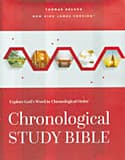
- The NKJV Chronological Study Bible by Thomas Nelson Publishers
The Chronological Study Bible reads like a historical epic from Genesis to Revelations. —Don
This Bible is a literal translation, but instead of following the traditional book-by-book arrangement, it presents the text of the NKJV in the order biblical events are believed to have occurred — complete with helpful notes, historical context, time charts, colorful graphics, and detailed maps.
You'll find this Bible very engaging to read, but it's not always easy to look up a specific verse because of its unique format. That said, it makes a great companion to your regular study Bible, helping to place biblical events in perspective.
Obtain your copy of The NKJV Chronological Study Bible from Amazon.com (As an Amazon Associate I earn from qualifying purchases).
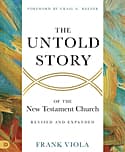
- The Untold Story of The New Testament Church by Frank Viola
It's like observing the lives of first-century believers in real-time. —Don
Frank Viola's revised and expanded 2025 edition of The Untold Story of The New Testament Church masterfully reconstructs the narrative of the Early Church, offering readers a unique chronological journey through The New Testament.
Building upon his original work, Viola weaves together the Book of Acts with the Epistles in proper order, combining historical details and inspired biblical scholarship. The 634 pages offer fresh insights into the people and events of first-century believers in real time. It's a gripping, easy-to-read resource for anyone seeking devotional reading, and its detailed endnotes will satisfy biblical scholars.
Obtain your copy of The Untold Story of the New Testament Church from Amazon.com (As an Amazon Associate I earn from qualifying purchases).
While chronological Bibles help you understand when biblical events occurred, interlinear Bibles take you deeper into how Scripture was originally written.
Interlinear Bible
Have you considered choosing a Bible translation that reveals the Word of God in the original Greek? Some readers consider getting an interlinear Bible to have as a companion resource to their main study Bible.
Interlinear Bibles display the original Hebrew or Greek text with a word-for-word English translation directly underneath each original language word, which is helpful for in-depth biblical language study.
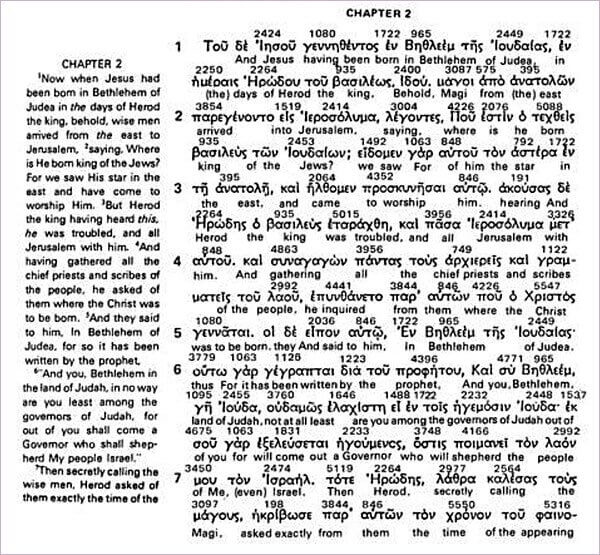 Example of Interlinear Greek-English Bible
Source: Qualifies as Fair Use
One example of a hardcover version is The Interlinear Bible Greek-English (Vol. IV New Testament) by Jay P. Green, Hendrickson Publishers (see sample image above).
The hardcover 720-page edition weighs in at almost 2½ pounds, so it's not what you'd call light reading (pardon the pun), but it's great for home study.
You can try this FREE online Greek-English Interlinear Bible to see whether investing in a hardcover version would be of interest.
Very few Christians ever develop the ability to read the New Testament in its original Greek texts. An interlinear Bible can help those with no prior knowledge of Greek to discover the nuances and layers of meaning within the original Greek texts.
Is an Interlinear Bible Right for You?
Interlinear Bibles are not for everybody's taste, and some students find that having access to a Strong's Exhaustive Bible Concordance is just as useful. Of course, you don't need to fill your bookshelves with multiple physical Bibles to access various translations and study tools in this digital age.
Choosing a Bible in the Digital Age
Would you prefer studying the Bible on your desktop computer, tablet, or mobile device? A Bible app offers not only easy reading and Scripture search but also provides a handy Christian reference library accessible at any time.

The Olive Tree Bible app is one that I use for all my online Bible studies, and I absolutely love it. —Don
As a perfect example, the Olive Tree Bible App offers access to a variety of popular Bible translations along with a selection of familiar commentaries, outlines, ancient maps, and more.
Your personal reference library is always accessible, even without Wi-Fi. The software is easy to use for Bible reading and Scripture searches, and it offers verse highlighting, copy-and-paste, the ability to add study notes, and numerous other features.
The amazing thing is it's free to download, although some add-on Bibles and reference books require purchase. Visit Olive Tree to read more about this amazing Bible app.
While digital Bibles offer tremendous convenience, many believers find value in also owning a physical Bible for deeper study, note-taking, and freedom from screen distractions. Consider your learning style and study habits when deciding between physical, digital, or both.
How to Maximize Your Bible Study
The Bible does not need to be rewritten, but it does need to be reread. —Anon.
The beauty of having multiple study Bibles available is that it allows you to compare scholarly approaches to the biblical text. Each translation style can offer unique insights, and using several can enrich our understanding of God's Word.
For instance, when choosing a Bible study approach, there is great value in consulting at least one literal translation, a paraphrase Bible, and possibly an interlinear Bible to determine what the Scriptures reveal. It's also worth noting that a Bible app enables you to take your inspirational library with you wherever you go.
Now that you understand the landscape of Bible translations and formats, let's bring everything together with some practical guidance.
Final Steps for Choosing a Bible That's Right for You
Here are some practical tips for picking a Bible that suits your reading style.
1. Start with Purpose
- Consider your primary goal: study, devotion, or both.
- Remember that different translations serve different purposes.
- It's often beneficial to use multiple translations.
2. Balance Accuracy and Readability
- Literal translations offer highest accuracy for study.
- Thought-for-thought translations provide easier readability.
- Paraphrases work well for light devotional reading.
3. Consider Your Growth Path
- Begin with a translation that matches your current needs.
- Plan to expand your Bible collection as your study deepens.
- Digital options offer flexibility and access multiple resources.
Practical Next Steps
Read sample passages from different translations before purchasing. For instance, Amazon features a wide variety of Bibles in hardcover, paperback, and Kindle editions. By using the "Look inside" feature, you can view a portion of the text to see whether it's suitable for your needs.
Choosing a Bible is not just a one-time decision but a lifelong investment in your spiritual growth. Take time to make an informed choice. Start with a reliable study Bible: NKJV, ESV, RSV, or NASB.
As you grow in your faith journey, you may find value in consulting multiple translations and digital study tools to gain fuller insights into Scripture. The best Bible translation is one that you'll read regularly and understand clearly, drawing you closer to God through His Word.
Ready to Begin Choosing a Bible?
Visit your local Christian bookstore or browse online retailers to explore these recommended translations. Start with sample passages from Romans 8 or John 1 to see which translation resonates with your heart and mind.
Remember that a moderately priced Bible you'll actually use is better than an expensive one that intimidates you. Many excellent study Bibles are available in the $30–50 range.
Browse Amazon.com to choose your new study Bible (As an Amazon Associate I earn from qualifying purchases).
Endnotes
1 Wilson, Andrew. "What's Wrong With the Passion 'Translation'?" Think Theology, January 6, 2016. thinktheology.co.uk/blog/article/whats_wrong_with_the_passion_translation.
2 Roth, Sid. "Brian Simmons." It's supernatural! Sidroth.org, June 13, 2016. https://sidroth.org/television/tv-archives/brian-simmons/.
3 The Septuagint (LXX) is the Koine Greek translation of the Old Testament that's quoted by the New Testament writers, particularly by Paul.
Reviews and Opinions Disclaimer
All reviews and opinions are provided for informational and educational purposes only. While I strive to provide accurate information, any claims of "misleading" or "incorrect" content represent my subjective assessment and honest belief based on personal analysis of the work. Readers are encouraged to conduct their own research and should not rely solely on the opinions found here as statements of fact.
About the Author

Don Bell is the creator of Kingdom Anointing and a dedicated follower of Jesus Christ. Drawing from decades of participating in small groups and conducting ecumenical retreats, he now focuses entirely on this online ministry—encouraging believers to seek God's Kingdom and walk daily in the Holy Spirit.

Encouraged by This Page? Please Share It
If this content encouraged you, please consider sharing this page. I choose to spend my time writing instead of posting on social media, so I rely on readers like you to help spread the word. Use the sharing buttons for Facebook, X, Pinterest, Reddit, and WhatsApp below!
 SCAN to access KingdomAnointing.com on your CELLPHONE
Hi, I'm Don
Welcome! I am an everyday believer whose life was transformed by a personal encounter with the Holy Spirit. After years of participating in small groups and conducting ecumenical retreats, I now focus entirely on this online ministry. Kingdom Anointing™ exists to help you build unshakeable faith, walk boldly in the nine gifts of the Holy Spirit, and step fully into your God-given destiny. Join me on this journey — the best of what God has for you is still ahead!
Freely Given
All content on this site is freely given. No outside ads. No donation requests. God provides!
Jesus says, "As you go, preach, saying, 'The kingdom of heaven is at hand.' ... Freely you have received, freely give" (Matthew 10:7–8).
Paul says, "For we are not, as so many, peddling the word of God; but as of sincerity, but as from God, we speak in the sight of God in Christ" (2 Corinthians 2:17).
The Lord Bless You
"The Lord bless you and keep you; the Lord make His face shine upon you, and be gracious to you; the Lord lift up His countenance upon you, and give you peace" (Numbers 6:24–26).

Privacy Policy | Site Policies | Contact Me
Unless otherwise noted, Scriptures are taken from the New King James Version (NKJV). Copyright © 1982 by Thomas Nelson, Inc. Used by permission. All rights reserved.

Copyright © 2019–2026 by Donald Robert Bell.
All rights reserved worldwide.
KingdomAnointing.com does not sell any personal information.
This site uses cookies for its operation and to enhance your experience. Privacy Policy