- Home
- Gospel of the Kingdom
- Kingdom of God Timeline
The Kingdom of God Timeline: 9 Major Events in Biblical History
By Don Bell / Kingdom Anointing
To truly grasp our current mandate as believers, it's helpful to understand the biblical history of God's Kingdom and how it has unfolded across the ages. As the Kingdom of God Timeline reveals, this journey is not merely a collection of ancient stories, but a divine chronicle of God's relentless pursuit to establish His dwelling place among His people despite cosmic rebellion.
We will walk through nine pivotal events — from creation and the initial perfection of Eden, to the subsequent falls of man and angels, to the arrival of the King in humility, and His eventual return in power. By seeing the "big picture" of the Kingdom timeline, you will find your unique place in God's unfolding plan for the ages.
The Ancient Foundations of God's Kingdom: Nine Major Events
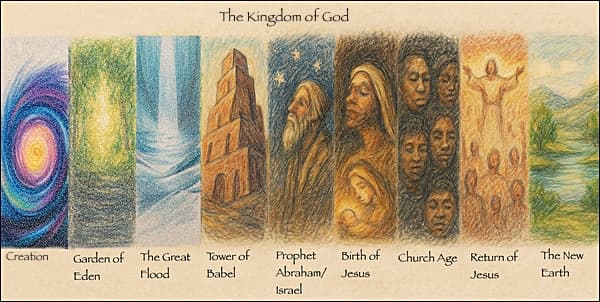 Nine Foundation Stages of the Kingdom of God
Source: ©Don Bell ✝︎
The concept of God's kingship and the establishment of His rule on Earth has existed since ancient times, long before Jesus was born. The following historical overview draws on the biblical narrative, including themes from the ancient cosmic conflict that provide context for God's Kingdom plan.
The Jewish people listened carefully whenever Jesus talked about God's Kingdom, because they held many different views and hopes concerning it, especially when it came to their day-to-day living in the midst of a harsh Roman occupation.
Why It Matters Today
As Christians living in the Church Age, the time between Pentecost and the future return of Jesus, we also need to understand Jesus' message of the Kingdom to be mindful of our calling to proclaim it as a witness to the nations until He returns (Matthew 24:14).
1. The Creation: Establishing God's Kingdom on Earth
The Old Testament (Tanakh) begins with God as the Creator of everything visible and invisible. It reveals that before God created Earth, He first created the heavens and the heavenly host, including unique beings whom He set apart to form His divine council in the heavenly realm.1
Whenever The Old Testament talks about these supernatural beings, they are called "gods" (Psalm 82:1) or "sons of God" (Job 1:6, 2:1) or "angels of God" (Genesis 28:12), but they weren't actually angels.
Scripture says they shouted for joy when Earth was created: "Where were you when I laid the foundations of the earth? Tell Me, if you have understanding. Who determined its measurements? Surely you know! Or who stretched the line upon it? To what were its foundations fastened? Or who laid its cornerstone, when the morning stars sang together, and all the sons of God shouted for joy?" (Job 38:4–7).
Much later, in The New Testament, Paul of Tarsus calls these same divine beings principalities, powers, and "spiritual hosts of wickedness in the heavenly places" (Ephesians 6:12). So what went wrong?
To figure this out, we must go back to the beginning.
After God made Earth, He made human beings to represent Him and have dominion over His earthly realm (Genesis 1:26–28). God had lovingly given "free will" to all His created beings, including humankind, enabling them to make their own choices, but its misuse led to rebellions in both His heavenly and earthly realms, interrupting His divine plan.2
2. The First Rebellion: How Satan Corrupted God's Earthly Kingdom
The first earthly rebellion took place in the Garden of Eden. Satan, a powerful cherub and possibly a high-ranking member of God's divine council, had tried to elevate himself above God (Isaiah 14:12–14; Ezekiel 28:12–17).
Satan influenced Adam and Eve, God's earthly representatives, to defy their Creator's instruction and choose their own path (Genesis 3:1–7). This rebellion severed humanity's intended partnership with God, resulting in their banishment from Eden (Genesis 3:22–24).
3. The Second Rebellion: Fallen Angels, the Nephilim, and the Great Flood
A heavenly rebellion occurred when some sons of God abandoned God's divine council to mix with humans on Earth and create their own hybrid offspring called the Nephilim.3
The rebellion of these heavenly sons of God not only got them condemned and bound in Hell waiting for judgement, their evil deeds corrupted the human population to such an extent that a worldwide flood became necessary to cleanse Earth and allow a fresh start with Noah and his family, the only righteous humans remaining then (Genesis 6:1–8; 2 Peter 2:4–5; Jude 1:6).
4. The Third Rebellion: The Tower of Babel and the Scattering of Nations
Following the Great Flood, human pride grew to hit its peak at Babel where the people gathered to decide their own future, not depending on God's plan for their well-being. In response, God confused their language and divided them into different nations, putting those nations under the rule of His divine council members, the sons of God who had remained true to Him (Genesis 11:1–9).4
However, even these heavenly sons of God would later rebel against Him and lead those nations into idolatry, worshiping not only them but demons, the wandering spirits of the part-human Nephilim who died during the Flood and later at the hands of Israel's armies in their conquest of the Promised Land.
5. Abraham's Promise: The Birth of God's Chosen Nation
It was time for God's backup plan; it was a secret plan that He had already prepared for this kind of crisis. It set the stage for the unique role of Abraham and his grandson Jacob who received a new name from God — Israel.
After Jacob's death, the name "Israel" became the collective term for his descendants, organized into twelve tribes, and the nation that God chose to be a light to the other nations got its start (Deuteronomy 32:7–12).5
God had promised Abraham that through his descendants, all nations would be restored and blessed. But, God's chosen people saw repeated failures and divine interventions, as corrupt kings and prophets played out their roles.
God inspired Isaiah and Daniel to prophesy of a future where a Messiah, an anointed king, would bring justice, healing, and peace to a broken world. The people of Israel were praying, hoping, and waiting for their promised king to arrive and make everything right and then — Jesus was born in Bethlehem.
6. The Kingdom Arrives in Christ: The Birth, Death, and Resurrection
Part 1: The Birth of Jesus
The Humble Arrival of the King
Jesus arrived not as the conquering warrior king Israel had long expected, but as a helpless infant laid in a manger inside a borrowed stable, His birth announced to common shepherds instead of kings or priests. Growing up in obscurity as a laborer's son in the overlooked town of Nazareth, He waited thirty years before stepping into the Jordan River to be baptized by John and receive his public anointing as the Holy Spirit descended upon Him (Luke 3:21–22)
Then, after forty days of fasting and being tested by Satan in the wilderness, Jesus returned to Galilee victorious and filled with the Holy Spirit to begin His ministry (Luke 4:14).
Standing in the synagogue at Nazareth, He declared His Kingdom mission in unmistakable terms, reading from Isaiah's scroll and announcing good news to the poor, liberty to captives, healing to the brokenhearted, and freedom to the oppressed. Then, He sat down and boldly declared that this Scripture was fulfilled in their hearing that very day (Luke 4:16–21).
Jesus didn't only talk about the Kingdom; He demonstrated it. What followed was three years of the Kingdom invading enemy territory with awe-inspiring power.
Jesus healed the sick, opened blind eyes, and cast out demons with a single command, and every miracle was a declaration of war against the kingdom of darkness. He also told parables about the Kingdom to give the people a better idea of what living in the Kingdom is really like. But that wasn't all.
Jesus had also come to do what no one else could do. He had come to deal with the root problem that had cursed all of creation since Eden.
He had come to die.
Part 2: The Death of Jesus
The Cross as Cosmic Victory
Scripture records, "And He, bearing His cross, went out to a place called the Place of a Skull, which is called in Hebrew, Golgotha, where they crucified Him, and two others with Him, one on either side, and Jesus in the center. Now Pilate wrote a title and put it on the cross. And the writing was: JESUS OF NAZARETH, THE KING OF THE JEWS" (John 19:17–19).
What appeared to the watching world as Satan's greatest triumph was in reality a cosmic ambush orchestrated before the foundation of the ages, with the powers of darkness blindly engineering the very act that would seal their own defeat.
"We speak the wisdom of God in a mystery, the hidden wisdom which God ordained before the ages for our glory, which none of the rulers of this age knew; for had they known, they would not have crucified the Lord of glory" (1 Corinthians 2:7–8).
On the cross, Jesus absorbed the full weight of humanity's rebellion, from Eden to the very end of time, so that we might become the righteousness of God in Him. When Jesus cried out "It is finished," He was declaring total victory, using the Greek word tetelestai (John 19:30). It was the very term stamped on ancient documents to mean paid in full, since every claim that sin, death, and Satan held against humanity was settled once and for all.
After Jesus had died, His body was removed from the cross and took by Joseph of Arimathea and Nicodemus to be prepared for burial and placed in a nearby garden tomb that would be sealed by rolling a heavy stone against its door (John 19:38–42; Mark 15:43–46).
But, the cross was not the whole story.
What happened next shook the world.
Part 3: The Resurrection of Jesus
The King Rises Triumphant
Three days later, on a Sunday morning, there was a great earthquake. An angel descended from Heaven, rolled back the heavy stone, and sat on it. The Roman guards shook with fear and fell to the ground like dead men (Matthew 28:1–4). And Jesus of Nazareth walked out of that tomb alive and triumphant over every power in the universe.
When the women arrived and found the tomb empty, the angel spoke words that would echo through all of eternity: "He is not here; for He is risen, as He said" (Matthew 28:6).
By rising from the dead, Jesus proved that He had conquered sin, defeated death, and stripped Satan of his ultimate weapon, the power of the grave (Hebrews 2:14–15). Death, which had reigned over humanity as a penalty since Adam, was now a defeated enemy.
The King was alive!
For forty days after His resurrection, Jesus appeared to His disciples and showed them His hands and His side. He ate with them. He kept teaching them about the Kingdom of God (Acts 1:3). He opened their minds to understand the Scriptures. And He commissioned them for the work ahead.
Then, on the Mount of Olives, with His disciples watching, He faded from view and ascended into Heaven (Acts 1:9–11), and "When He ascended on high, He led captivity captive, and gave gifts to men" (Ephesians 4:8).
But He did not ascend to rest; He ascended to reign.
Jesus entered the heavenly throne room and sat down at the right hand of the Father. The Son of Man from Daniel's vision had received His Kingdom: "Then to Him was given dominion and glory and a kingdom, that all peoples, nations, and languages should serve Him" (Daniel 7:14).
Before He ascended, He had made a promise to His followers that would change the course of human history:
"You shall receive power when the Holy Spirit has come upon you; and you shall be witnesses to Me in Jerusalem, and in all Judea and Samaria, and to the end of the earth" (Acts 1:8).
The King was leaving, but He was not leaving His people alone.
He was sending Someone.
7. The Church Age: Believers Commissioned to Advance the Kingdom
The Church Age began on the Day of Pentecost when the Holy Spirit descended upon the disciples in Jerusalem, empowering them to be Christ's witnesses "to the end of the earth" (Acts 1:8).
This event marked a dramatic shift in God's redemptive plan. The Kingdom of God, which Jesus had inaugurated through His life, death, and resurrection, would now advance through His followers as they proclaimed the gospel and demonstrated His power.
From that moment until Christ returns, we live in this unique era where the Kingdom has come but is not yet fully realized. During this time, God is calling people from every nation to enter His Kingdom through faith in Jesus Christ, and He's doing it through His Church.
The Church is the Body of Christ and not the Kingdom itself; it's the community of born-again believers who have entered the Kingdom to live under Jesus' kingship and continue what He started. It's also a preview of the Kingdom to come, and believers have been given an important role to play.
Scripture says, "All things are of God, who has reconciled us to Himself through Jesus Christ, and has given us the ministry of reconciliation, that is, that God was in Christ reconciling the world to Himself, not imputing their trespasses to them, and has committed to us the word of reconciliation" (2 Corinthians 5:18–19).
This ministry of reconciliation isn't just for ordained leaders, its for ALL believers.
Jesus prophesied, "'This gospel of the kingdom will be preached in all the world as a witness to all the nations, and then the end will come'" (Matthew 24:14).
WE are called to announce God's message of reconciliation to the world, "as though God were pleading through us" (2 Corinthians 5:20), and it's the job of the ordained leaders to prepare us, the Body of Christ, for this important work (Ephesians 4:11–12).
8. The Second Coming: Christ Returns to Establish His Kingdom
Jesus has promised to return one day to fully establish His Kingdom on Earth. This "Second Coming" (Matthew 24:30–31) will be seen as a worldwide event that brings an end to all evil, injustice, and suffering.
It's not the escape from a troubled Earth to a peaceful Heaven that some might think; it's life on Earth where King Jesus fully reigns in righteousness and peace and joy.
9. The Kingdom Fulfilled: God's Eternal Reign on a New Earth
Scripture says, "Nevertheless we, according to His promise, look for new heavens and a new earth in which righteousness dwells" (2 Peter 3:13). God will restore all creation to its intended purpose, ushering in "new Heavens" and a "new Earth"; it's the consummation of the story that began in Creation.
Key Takeaways: The Timeline
✓ Ancient Roots, Eternal Plan: God's Kingdom plan spans from Creation to the New Earth.
✓ Victory Over Rebellion: God has consistently moved to restore His rule despite spiritual and human rebellions.
✓ The King Has Come: The First Advent opened the door to the Kingdom through the Cross.
✓ We Live in the "Between": We are currently in the Church Age, tasked with expanding the Kingdom through the Spirit.
Connecting the Kingdom of God Timeline to Personal Priority
Understanding the Kingdom of God Timeline provides the essential historical context for our faith, showing us that we are part of a grand, eternal narrative. We see that God has always been working to restore His rule on Earth as it is in Heaven.
Now that we understand the "what" and the "when" of the Kingdom, it is time to focus on the "how." In Part 3, we will dive deep into the specific command of Jesus to understand what "seek first the Kingdom of God" means for us in the midst of life's many distractions.
Continue to Part 3: Seeking the Kingdom of God
Endnotes
1 Additional reading regarding God's divine council: Heiser, Michael S. "The Unseen Realm." Lexham Press, Bellingham, WA, 2015.
Obtain your copy of The Unseen Realm by Dr. Michael S. Heiser from Amazon.com (As an Amazon Associate I earn from qualifying purchases).
2 Ibid.
3 "There were Nephilim (men of stature, notorious men) on the earth in those days—and also afterward—when the sons of God lived with the daughters of men, and they gave birth to their children. These were the mighty men who were of old, men of renown (great reputation, fame)" (Genesis 6:4 AMP).
4, 5 Moses wrote, "Remember the days of old, consider the years for past ages: ask thy father, and he shall relate to thee, thine elders, and they shall tell thee. When the Most High divided the nations, when he separated the sons of Adam, he set the bounds of the nations according to the number of the angels of God. And his people Jacob became the portion of the Lord, Israel was the line of his inheritance." (Deuteronomy 32:7–9 LXX).
The Septuagint (LXX) is the Koine Greek translation of The Old Testament that's quoted by The New Testament writers, particularly by Paul. The literal translation "angels of God" ("sons of God" by Symmachus and NIV, NASB, ESV, HCSB, NLT Bibles) is supported in the oldest available Hebrew texts, the Dead Sea Scrolls.
✝︎ Kingdom of God Timeline © 2025 by Donald Robert Bell. All rights reserved. Original compilation, labeling, and modification by the author; contains base assets generated via Leonardo.ai.
In This Series
About the Author

Don Bell is the creator of KingdomAnointing.com and a dedicated follower of Jesus Christ. Drawing from decades of serving the Body of Christ through small groups, ecumenical retreats, and personal prayer ministry, he now pours his experience into this digital ministry—encouraging believers to seek God's Kingdom and walk daily in the fullness of the Holy Spirit.

Encouraged by This Page? Please Share It
If this content encouraged you, please consider sharing this page. I choose to spend my time writing instead of posting on social media, so I rely on readers like you to help spread the word. Use the sharing buttons for Facebook, X, Pinterest, Reddit, and WhatsApp below!
 SCAN to access KingdomAnointing.com on your CELLPHONE
Hi, I'm Don
Welcome! I am an everyday believer whose life was transformed by a personal encounter with the Holy Spirit. After years of participating in small groups and conducting ecumenical retreats, I now focus entirely on this online ministry. Kingdom Anointing™ exists to help you build unshakeable faith, walk boldly in the nine gifts of the Holy Spirit, and step fully into your God-given destiny. Join me on this journey — the best of what God has for you is still ahead!
Freely Given
All content on this site is freely given. God provides!
Jesus says, "As you go, preach, saying, 'The kingdom of heaven is at hand.' ... Freely you have received, freely give" (Matthew 10:7–8).
Paul says, "For we are not, as so many, peddling the word of God; but as of sincerity, but as from God, we speak in the sight of God in Christ" (2 Corinthians 2:17).
The Lord Bless You
"The Lord bless you and keep you; the Lord make His face shine upon you, and be gracious to you; the Lord lift up His countenance upon you, and give you peace" (Numbers 6:24–26).

Privacy Policy | Site Policies | Contact Me
Unless otherwise noted, Scriptures are taken from the New King James Version (NKJV). Copyright © 1982 by Thomas Nelson, Inc. Used by permission. All rights reserved.


Copyright © 2019–2026 by Donald Robert Bell.
All rights reserved worldwide.
KingdomAnointing.com does not sell any personal information.
This site uses cookies for its operation and to enhance your experience. Privacy Policy